Showing posts with label Herb Farm. Show all posts

Friday, December 5, 2014

Farm Day: Little Red Bird Botanicals - Roots and Seeds


Where did the year slip off to? It seems just last month I was photographing budding cohosh and baptista in the garden. But the blossoms have all withered, the vibrant reds, yellows, purples and greens have mostly all faded to browns, and the time of the root is thick upon us.

While the backyard ornamental and vegetable gardeners may already be knitting their winter sorrows, the herbal gardener knows better. 
Late fall is the time to harvest root medicine and save seeds for next year's garden.
On a surprisingly warm day at the end of November I joined Holly of 
Little Red Bird Botanicals to harvest and close up shop for the winter. 

There were many surprises hiding around the garden. The rue was still in full swing, as if it hadn't noticed the cold, several Praying Mantis egg sacs were found, holding the almost microscopic bodies of hundreds of next generation predators, and some shockingly vibrant colors were unearthed in our root digging process as we harvested echinacea and ginger.

We dug the marshmallow root that has been growing for three years and foraged for yellow dock and dandelion roots. We even harvested a whole bucket of sunchokes that we layered between levels of dirt for storage for the winter. 

Praying Mantis egg sac

Mullein 
Echinacea root buds in neon pink
Ginger roots
Echinacea 


Tiny sprouts on the Marshmallow Root 

The pinwheel seeds of the Marshmallow - a trademark of the whole family

the sunchoke harvest


Thursday, July 17, 2014

Farm Day: Little Red Bird Botanicals - Late Spring


 Visiting the garden for the first time with Holly had been so magical and inspiring that I was sure I would be zipping around the beltway once a week to sit and chat and pull a few weeds. 
Weeks passed and time spent at Centro Ashe and Arcadia along with day to day life found me pulling into a spot in the gravel lot at Clagett almost a month after my first visit. 

What had changed? What progress had I missed?

Remember the chamomile seedlings from the last visit?


Well into May spring was quickly slipping into summer and the plants had shot up in my absence, as they do. We rummaged around in the greenhouse together, Holly fretting over plants that had languished a bit, making a mental list of the "must plant today" and the "sorry maybe later"specimens. 


Bitter melon fell to the "must plant today" list so we found some seats on the ground near the bed and started digging shallow holes for the seedlings. Bitter melon, like all bitter foods, can be used to stimulate bile production and treat things like constipation and sluggish digestion. It also has uses for lowering blood sugar for diabetics as well as treating skin diseases and even cancer and HIV/AIDS. 

As we planted I asked questions about the plants like "What will the next phase of this plant look like?" Holly answered me in her slow, measured way, never really breaking focus from her planting but occasionally demonstrating shapes with her hands and throwing quick glances my way to gauge me comprehension. 


The passionflower (above) had wound its way out of the ground since my last visit and was preparing to flower while the baptista (below) was only days away from sending out her little purple flags.


Goldenseal (Hydrastis Canadensis) is one of those plants that warms the herbalist's heart when it's seen growing in a garden. Long over harvested and over wildcrafted, the yellow thready rhizome of this palmate beauty is used to treat a myriad of illnesses and infections but it's popularity has put it on the list of rare and at risk plants. Even our own neighboring wildernesses like Monogahela National Forest in West Virgina no longer sells permits for collection because the herb has become even scarcer than American Ginseng. In the summer goldernseal sends up a fruit very similar to a raspberry with a cluster of thirty some seeds. 


"What else is particularly lovely this time of year?" I asked. Holly thought for a minute. 
"Horseradish!" she shouted over to me. "Soon it will be all chewed up and bug ridden and since I only harvest the root there is no sense in trying to combat them so it starts to look much less photogenic the further in the to season you get." 

Horseradish with its easily identifiable long, rippling leaves. 


The peonies that had been little alien stumps rising from the earth on my first visit had produced bulbous head and sweet nectar dripped from the lining of the bulb that the ants greedily collected.  


For our last little task for the day we harvested Stinging Nettle (Urtica dioica) which grows all along a fence line down the gravel path from Holly's plot. We grabbed paper bags and leather palmed gloves and some shears and walked down to the patch, scaring a mole back into his hole as we approached.

"I never mind the sting much. If you do get stung you may notice a tingling later, like your hand fell asleep, and I always have to remind myself it's because I got stung earlier. It fades pretty fast after the initial sting. I used to cook them to get the sting out but I've found even just tossing them in a blender does the trick," Holly explained as she snipped away and I tentatively took my first go at it. 

We hewed our way down the line.
 "I always feel a little bad, I basically come in and decapitate all the male plants here. So I like to come back later in the season and just kinda say hey and give them some attention to let them know I don't just come to cut them down."

"How do you know they are males?"

"Well that's kinda complicated really and I didn't know it at first but suffice it to say that now I know that those over there," she pointed to the stand growing along the fence running perpendicular to the fence we stood bent over, "are the females and these are the males. So I usually take from the males and leave the females to reproduce." 

All these things I never had considered….


As we walked back towards the cars she pointed out the Wild Choke Cherry 
(Prunus virginiana).
 "Those blossoms won't be around for much longer but then we'll get the berries. Most people don't like them because they're so sour but I eat them."

"You can eat any fruit it it's made into a jam,"I thought to myself, making special note of the other characteristics of the tree for future identification.


I wonder what summer will bring? 

Sunday, April 27, 2014

Farm Day: Little Red Bird at Clagett Farm


Holly of Little Red Bird Botanicals tends a small plot at Clagett Farm. Amidst the farmyard chaos and despite the screech of the turkey she's managed to carve out a little slice of herb filled peace over the last five years. There's an air of quiet anxiety when a gardener first visits their piece of land after a hard winter. A held but hopeful breath. 
Will the plants come back? What was lost? What survived?

Keesa enjoying the sunshine

My experience with farming and gardening has always been with with the more macho sense of the word. Beefy tomato plants get yanked and discarded at the end of the growing season, seeds are snatched and hung if they are even kept at all, and a quick batch of winter-kill field peas gets thrown into the ground to the mercy of the first freeze.

An herbal garden is much different.  

Peonies 
As we approached the bed Holly and her mother started to call out the name of plants. 
"Oh look at the Mullein popping up."
"Good, we've got peonies here and over there the hyssop is looking good already."

As we surveyed the survivors I was struck by just how different this first day felt from past first days on agricultural farms. There was such palpable rebirth and regeneration here. 
Like seeing old friends at your old favorite bar. 

Black or perhaps Blue Cohash

I spent the morning with Holly getting acquainted with her herbs, my head reeling with all the new plant names. We attended to each plant as individuals. Some budding plants needed to be freed from smothering encroachers, others we covered in a soft blanket of pine needles and others we just simply recognized with a few words before moving to the next.
As you weed an herbal medicine garden you learn that the traditional foes of farming: the chickweed, dandelion, plantain leaf and dead nettles, aren't really foes anymore. But even friends can overstay their welcome and butt in where they aren't invited so out we plucked them. We made a tidy little pile of chickweed for Holly to bundle home and mix into her smoothies. She praised their superior nutrition and invited us to take chickweed as well. 
But wait. If they are so nutritive why cast them out of the garden?

"I don't bother growing things like chickweed in my garden when it's so abundant in our environment. Why plant something I can easily wildcraft?" Holly explained.

And she's right. Walking from my car to my apartment later that day I spotted chickweed growing between sidewalk slabs and clustered around the front steps. It's everywhere if you know what to look for. But where does one wildcraft in the city? How does one know where it's safe? 

I still have much to learn it seems.


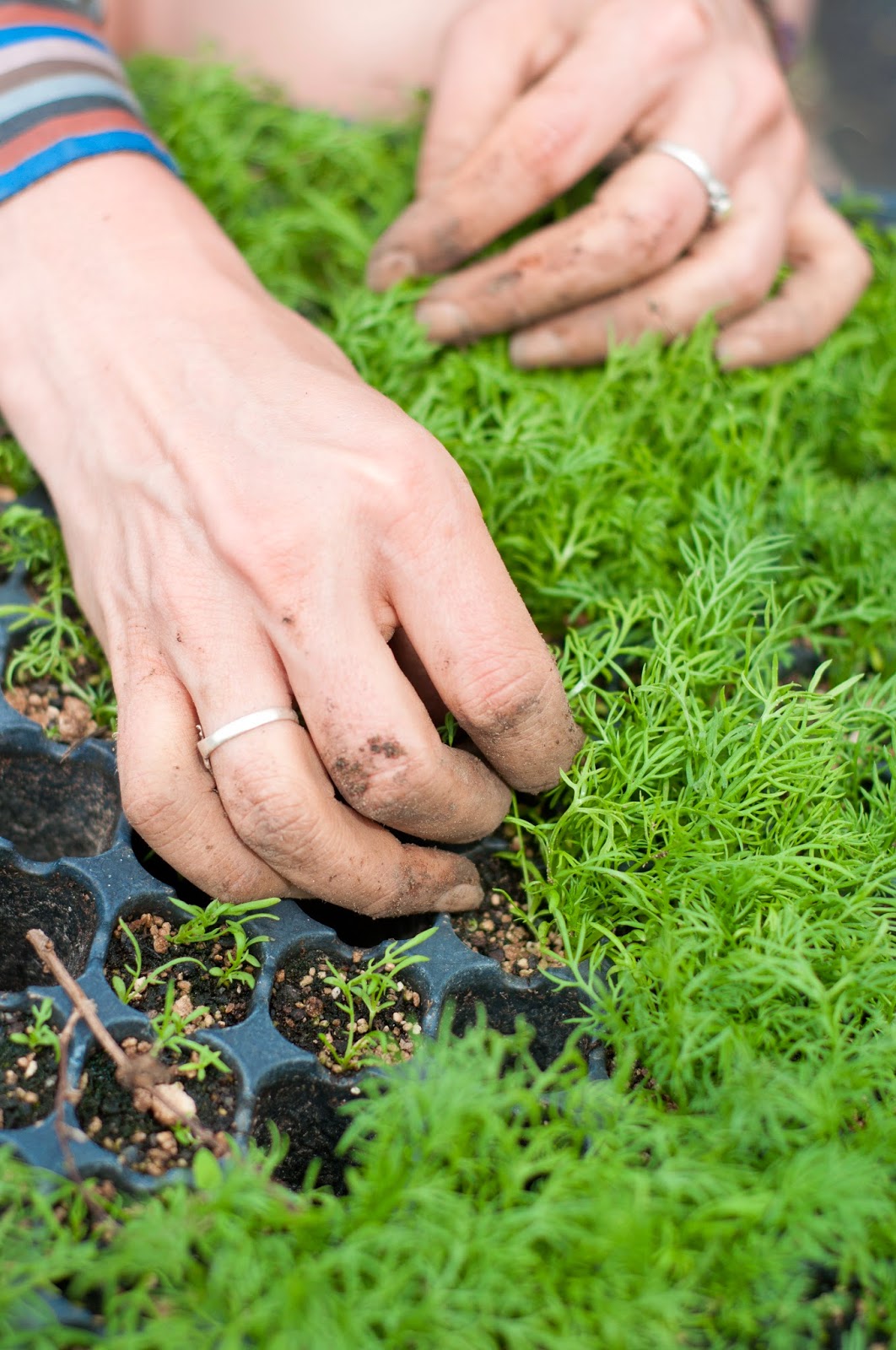
The time passed quickly with multiple hands at work and before we knew it the weeds were gone and it was time to wake up the nursery and start planing some seedlings. I watched and chatted with Holly as she placed the chamomile seedlings in neat little rows.


"I wish it was possible to get just one seed in each little hole, you know. It always ends up being these little clusters that you have to pull apart. But I'm going to plant them pretty close together so they grow up kinda bushy, like one big chamomile bush."

The slow, intentional act of planting is such a calming experience. 


I'll be helping Holly throughout her growing season this year and documenting the growth of the garden and I can't wait to learn more. She sent me home with a hyssop and several little chamomiles of my own that I dutifully planted in close knit rows. Now all there is to do is water and wait.