Showing posts with label herbal medicine. Show all posts

Sunday, November 2, 2014

Beginning the Herbal Medicine Path: Part 2


I'll admit I was a bit miffed when I started hearing herbalists referring to their use of Plantain Leaf as a great locally foraged medicine. 
"Where on Earth are they locally sourcing this banana leaf," I thought, my mind going to the only plantain I have ever heard of, the long green variety that is fried up in Central America to make a delicious starchy chip. 
Plantago Lanceolata and Plantago Major are exotic sounding names for the different varieties of the first inconspicuous looking medicine we set out to study.

This plantain happens to be long and green too. Or, well, round and green if you find Plantago Major instead of Plantago Lanceolata. 

But as it turns out, we're all familiar with plantain leaf. Yes, even the couch dwellers of us. If you've walked across a grassy patch between your car and a store you've probably unintentionally trampled on plantain leaf. Plantago actually means "sole of the foot" in Latin, so these little guys are used to being trampled I suppose. 


Plantago Lanceolata

On our first day of class we had spent the morning learning words like 'cholagogue' and 'demulcent' and herbal energetic words like 'cooling' and 'toning' and were itching to find these magical plants that corresponded to these new words.
So we ventured out of the classroom and into the garden.

Plantain is a panacea, according to any herbalist you ask. It has so many uses and energetics attributed to it but it is probably best well known for it's healing properties for skin. Plantain is a vulnerary that is renowned for it's cooling and drawing energetics, which explain why it's history is awash with bee stings, mosquitos bites, eczema and even snake bites. 

On this unseasonably warm April day we learned first hand how to ease the discomfort of mosquito bites. As the flying beasties stretched their wings and tested their proboscises for the first time that year, we budding herbalists reached for leaf after leaf from the ever giving plantain plant. 

The method we learned is simple: pick a leaf from an unsprayed plant (don't pick a leaf from the side of a road that has been choked with car exhaust or a leaf from an herbicide doused yard), put the leaf in your mouth and chew, now spit (or if you are a lady, remove said chewed herb and gently place it) on the offending bite, and that's it.
I'll say I was skeptical of this chew and spit process.


My personal saga with mosquitos is as follows - as long as I have taken in breath and expelled carbon dioxide the mosquitos have sought me out. Whether it's because I eat too many sweet bananas or my skin is just thin enough for them to easily pierce it I couldn't say, but what I can say is that each tiny pinprick I receive quickly swells and blossoms to a deep red, rounded raspberry. The itch is intense. The mark indelible and inconsolable. 
I've grown accustomed to applying plasters of inefficient antihistamine creams.
Even after the poison disperses and the itch retreats a pimple-imposter lingers for many more days.
That is until I met Plantago.


My first bite of the day received a timid but hopeful spit poultice. As did the second and third. And as I traveled home that day with close to 10 bites, I had forgotten about them before I had even eaten dinner. No red lumps, no clawing itch. Just a tiny pinprick that seemed to shrink to nothing within a day or so.
 Magic?
No, Medicine. 

While plantain grows all around us, availability of unadulterated plantain is not always as easy to find. So after experimenting with fresh plantain we set out to make a salve, something we could carry with us in the city, through the desert and into our homes to ease cuts, bruises, burns and bites. 

As a class we gathered plantain leaf and dandelion flower to make our salve, learning that dandelion has antibacterial properties that can assist in wound healing and cleaning up acne and other blemishes.


The process of making a salve seemed so intimidating. What if we did it wrong? Was this flower good enough? What if there were bugs on the flowers?

Molly has a way of making medicine so approachable though. We gathered our ingredients together in a carved gourd basket and then plopped them on a baking sheet and threw them in the oven on a super low temperature to wilt (to expel excess moisture content). If we had wanted to take the leisurely route we could have laid them out in the sun for a bit and sipped our tea until they wilted, or just set them out overnight, but we were all in such high energy spirits that we wanted to see this salve made as quickly as possible. 

After the flowers were wilted we chopped our plantain leaves and flowers, allowing the cell walls of the marc (the herb) to open so that the medicine could be better absorbed into the menstreum (the oil).
Then we had a choice. Use a little heat and meld the herbs with the oil, or use no heat and let the herbs meld slowly over the period of a few weeks.
The thought of waiting a few weeks to see our finished product seemed terrible so we made haste to the stove and over very low heat we swirled the oil and herbs together, taking shifts the rest of the class to stir the pot for several hours. 
Once the oil had absorbed the plantain and dandelion we strained the marc out and were ready to add our solidifying agent, beeswax (as a side note, vegans can opt for shea butter or coconut oil), and within seconds of adding the beeswax our salve was taking shape and we quickly poured it into little tins to cool and take home. 

But that wasn't all we were making on our first weekend of herbalists. An herbalist would be amiss to not learn the helpful skill of tincture making.

A tincture is an extract of herbs in alcohol. Think of vanilla extract. If you've ever made vanilla extract at home then you've already mastered the skills of tincture making. 
For our first tincture we looked to the garden again, or more correctly, we looked to the grass. Hidden among the tall blades of grass, the clover and plantain, lay everyone's old friend, dandelion, freshly robbed of her yellow ringed hat.
As we had learned over our morning tea, dandelion root is a strong medicine for the kidneys, promoting liver health and encouraging waste evacuation through the bladder due to it's diuretic action. So we set about digging the tender roots of the dandelion.


"Now remember when we use root medicine we are taking all of the plant, we are taking it's life completely to make our medicine," Molly said, as she stroked the root she had just dug as a demonstration. "Dandelion root is a beautiful medicine, but your intention as you gather medicine is just as important as the medicine itself. Consider thanking the plants that are giving their lives for your medicine." 


 After collecting and washing our dandelion roots we set them out in the sun to dry. Then we chopped the roots, opening the cell walls, and threw them, while giving proper thanks, into a large mason jar and filled the jar almost to the top with brandy. Molly prefers to use brandy in her tinctures, because that's the alcohol she learned to use in tincture making, but any alcohol over 80 proof will work. Then we sealed up the jar and set it in a cool, dark spot to meld. Every day or two the tincture should be shaken to move the plant material around and after 4 to 6 weeks it can be pressed out and used. 


As we prepared our tincture Molly passed around berries and roots and leaves of different plants to try. We smelled rose petals and chewed on hawthorn berries and sucked on sweet licorice. And then quite out of the blue, under the sway of all the bountiful tastes and smells around us, Molly declared, "Let's make a love potion!"


The faint of heart, those afraid of voodoo and becoming a potion brewing witch, may have balked at this idea. But after spending the morning harvesting plants and roots, after making a salve and a tincture, a love potion suddenly didn't feel so silly. 
Sure, it wouldn't pierce the heart like a cupids arrow. We didn't expect any Hollywood fireworks to shoot off after taking the tincture. But slowly the idea that medicine doesn't always have to be this forceful, strict, and expedient word, that medicine can be something that coaxes your mood, that softens your affections, that supports your natural state, or simply be something that takes your mind to another place, that idea had begun to sink in. 

A word has the power to loosen itself of it's societal fetters if you give it the chance. 

Medicine is defined as a substance used to treat an illness or a disease. A remedy. 
Health, in many medical circles, is defined as the absence of disease. 

But in herbal medicine, as well as many other types of natural medicine, health and medicine are much broader terms. Health is a state of balance, a positive state of well-being that encompasses all the aspects of your mental and physical life. 
Medicine supports that. 
Music is medicine. Gardening is medicine. And yes, even love potions are medicine. 


Monday, September 29, 2014

Beginning the Herbal Medicine Path - Part 1


Sleepily we gathered for our first weekend of Grassroots Herbal Medicine, letting piping streams of maple colored tea flow from the samovar into our outstretched mugs before sinking down into a chair to wait for the magic to begin.

All ages of women had assembled into our circle of eager herb wielders, from the salt tinged hair of one women to the budding, rounded belly of another. We introduced ourselves somewhat timidly, each secretly wondering what the other person already knew about herbal medicine.


As each of us found our seats Molly welcomed us, radiating the warmth teachers seem to so easily exude when they are blessed with a classroom of intention-filled students. Molly holds a presence in the space that is undeniable, swathed in chocolate dreadlocks and a knit sweater she beamed at us over her own cup of steaming tea.

She asked us to pick up our cups. 

"What do you smell?"

We brought the wisps of steam to our noses and inhaled. I was reminded of my first attempts at wine tasting. The swirling red liquid sending only heady whiffs of alcohol to my nostrils. Only with months of practice did I start picking notes of leather, chocolate, honeysuckle and plum. 

"It smells kinda sweet," a young girl to my right said.

"Hmmm sweet, interesting," Molly mused, letting silence fall again to open the floor to more guesses.

"Yeah, kinda like a sweet earthiness is what I get," another woman said, her nosed still pressed to the rim of her mug.

"What part of your body does this tea go to?" Molly asked.

"How can I feel that?" I wondered. I took another sip, willing my body to tell me where the plant was drawn to. I felt the warmth of the liquid flowing down my throat, emanating out through the skin of my neck. And I felt the warmth enter my stomach, sending that little thrill up to my brain, the first buzz of the morning alarm to rouse the sleeping senses. 

"I feel it in my kidneys," someone said, letting her hand graze her side for emphasis. 
Molly nodded with a smile and I sipped again, stretching my nerve ending out to feel my kidneys. 

"What part of the plant do you think this comes from?"
We looked a little confused perhaps because she quickly offered, "Is it a bark? Is it a berry? Does this taste like the leaves, or maybe the root?"

"Leaves?" someone guessed? 
Every part was thrown out in hushed whispers, no one quite sure.

"Are there any guesses for what plant this is?" Molly asked.

No one offered up a guess.
"This is dandelion root tea," Molly smiled, "Taxicum officinal," she said in latin.
There were whispers of "I knew it!" from a few and looks of "really, dandelion?" from a few others.


With one simple exercise we had been thrown into the world or herbalism. Herbalism is not a study so much as it is a way of life. It is an intention of joining yourself with the plant world in a way that seems foreign and at times silly and so far removed from our current sphere of life. 

 I had come to this class wondering what possible connection I could find. I worried a little about the ideas of appropriation, exoticism and novelty seeking. Would I be hoodwinked into potion making? Would I foolishly delve into traditions that had no bearing on my personal history?

As if sensing this discomfort, these open questions and uncertainties, Molly began that morning by sharing her own story. Her exploration of Costa Rican medicine, her experiences at Sacred Plant Traditions in Charlottesville, her decision to come back to her home of Maryland and start a school. 
But more importantly she shared this thought with us: 

"Every single one of us come from a lineage of plant people."

Perhaps I can't claim any bloodline to inform my use of astragalus, and maybe I don't belong to a people who used tobacco medicinally, but somewhere in my history, my personal lineage, I come from a people who used plants as healers. We all do.  
The room filled with excited buzz as I imagine we all thought about our own families and what traditions might be buried in our pasts. What plants, perhaps even plants in this very garden, might have played a role in our histories.


The Grassroots program, Molly explained, is meant to make herbal medicine approachable, after all, herbal medicine is for the people and is made by the people. 

There is no certification out there really that is accredited. You don't have to know every plant under the sun.  Your depth is completely up to you. If you are called to make teas from your garden and to use herbs in your stews, you're an herbalist. If you make salves and tinctures and poultices, you're an herbalist. 
If you form a relationship with even just one plant, you're an herbalist.

"Congratulations," she smiled, "You're all herbalists now."

Becoming an herbalist was as simple as deciding. 


And with that knowledge, that confidence that we hadn't even dreamed of gaining on the first day, we dove into our exploration.

Thursday, July 17, 2014

Farm Day: Little Red Bird Botanicals - Late Spring


 Visiting the garden for the first time with Holly had been so magical and inspiring that I was sure I would be zipping around the beltway once a week to sit and chat and pull a few weeds. 
Weeks passed and time spent at Centro Ashe and Arcadia along with day to day life found me pulling into a spot in the gravel lot at Clagett almost a month after my first visit. 

What had changed? What progress had I missed?

Remember the chamomile seedlings from the last visit?


Well into May spring was quickly slipping into summer and the plants had shot up in my absence, as they do. We rummaged around in the greenhouse together, Holly fretting over plants that had languished a bit, making a mental list of the "must plant today" and the "sorry maybe later"specimens. 


Bitter melon fell to the "must plant today" list so we found some seats on the ground near the bed and started digging shallow holes for the seedlings. Bitter melon, like all bitter foods, can be used to stimulate bile production and treat things like constipation and sluggish digestion. It also has uses for lowering blood sugar for diabetics as well as treating skin diseases and even cancer and HIV/AIDS. 

As we planted I asked questions about the plants like "What will the next phase of this plant look like?" Holly answered me in her slow, measured way, never really breaking focus from her planting but occasionally demonstrating shapes with her hands and throwing quick glances my way to gauge me comprehension. 


The passionflower (above) had wound its way out of the ground since my last visit and was preparing to flower while the baptista (below) was only days away from sending out her little purple flags.


Goldenseal (Hydrastis Canadensis) is one of those plants that warms the herbalist's heart when it's seen growing in a garden. Long over harvested and over wildcrafted, the yellow thready rhizome of this palmate beauty is used to treat a myriad of illnesses and infections but it's popularity has put it on the list of rare and at risk plants. Even our own neighboring wildernesses like Monogahela National Forest in West Virgina no longer sells permits for collection because the herb has become even scarcer than American Ginseng. In the summer goldernseal sends up a fruit very similar to a raspberry with a cluster of thirty some seeds. 


"What else is particularly lovely this time of year?" I asked. Holly thought for a minute. 
"Horseradish!" she shouted over to me. "Soon it will be all chewed up and bug ridden and since I only harvest the root there is no sense in trying to combat them so it starts to look much less photogenic the further in the to season you get." 

Horseradish with its easily identifiable long, rippling leaves. 


The peonies that had been little alien stumps rising from the earth on my first visit had produced bulbous head and sweet nectar dripped from the lining of the bulb that the ants greedily collected.  


For our last little task for the day we harvested Stinging Nettle (Urtica dioica) which grows all along a fence line down the gravel path from Holly's plot. We grabbed paper bags and leather palmed gloves and some shears and walked down to the patch, scaring a mole back into his hole as we approached.

"I never mind the sting much. If you do get stung you may notice a tingling later, like your hand fell asleep, and I always have to remind myself it's because I got stung earlier. It fades pretty fast after the initial sting. I used to cook them to get the sting out but I've found even just tossing them in a blender does the trick," Holly explained as she snipped away and I tentatively took my first go at it. 

We hewed our way down the line.
 "I always feel a little bad, I basically come in and decapitate all the male plants here. So I like to come back later in the season and just kinda say hey and give them some attention to let them know I don't just come to cut them down."

"How do you know they are males?"

"Well that's kinda complicated really and I didn't know it at first but suffice it to say that now I know that those over there," she pointed to the stand growing along the fence running perpendicular to the fence we stood bent over, "are the females and these are the males. So I usually take from the males and leave the females to reproduce." 

All these things I never had considered….


As we walked back towards the cars she pointed out the Wild Choke Cherry 
(Prunus virginiana).
 "Those blossoms won't be around for much longer but then we'll get the berries. Most people don't like them because they're so sour but I eat them."

"You can eat any fruit it it's made into a jam,"I thought to myself, making special note of the other characteristics of the tree for future identification.


I wonder what summer will bring? 

Friday, June 27, 2014

Exploring Home: Stabler-Leadbeater Apothecary Museum


Centro Ashe has been opening up a whole new pathway in life for me to joyfully skip down. My head whips back and forth at stoplights marveling at the stands of roadside echinacea, I'm cultivating new acquaintances in my garden like motherwort and hyssop, I'm kneeling in stranger's front yards and on sidewalk cracks trying to identify new plants and now a whole new genera of museums has come to my attention.
 And luckily I have one in my own backyard.

The Stabler-Leadbeater Apothecary has been here the whole time. In fact it's been here almost as long as Alexandria itself - starting in 1792 and running till 1933. 

As we toured the apothecary with it's glass bottles full of magically colored powders, tiny crystal vials and heavy wooden drawers full of herbs I couldn't help but daydream about a modern apothecary. A renascence of people using whole plants to support their lives. Beautiful shops full of gorgeous tinctures and salves and teas and a marble soda fountain.

This used to be the norm. 


As you climb the stairs to the room with floor to ceiling drawers, all hand painted with herbal names, you can't help but feel like you've stepped into a Harry Potter story with drawers like Mandrake Root, Unicorn Root and Dragon's Blood Reeds. 


The tour is a quick 30 minutes and winds through the wholly unchanged two floors of the apothecary. Even the powders and liquids still smudged into bottles are original from the 1930's when the apothecary shut its doors. The docent carries an iPad with pictures of herbs pulled up to show you what Unicorn Root actually looks like and to pull up lists of herbal actions for the inquisitive herbalist visitor. 


105 -107 South Fairfax Street 
Alexandria, VA 22314 
703 - 746 - 3852

Tours start at 15 till or 15 after the hour.
Admission is $5


Sunday, April 27, 2014

Farm Day: Little Red Bird at Clagett Farm


Holly of Little Red Bird Botanicals tends a small plot at Clagett Farm. Amidst the farmyard chaos and despite the screech of the turkey she's managed to carve out a little slice of herb filled peace over the last five years. There's an air of quiet anxiety when a gardener first visits their piece of land after a hard winter. A held but hopeful breath. 
Will the plants come back? What was lost? What survived?

Keesa enjoying the sunshine

My experience with farming and gardening has always been with with the more macho sense of the word. Beefy tomato plants get yanked and discarded at the end of the growing season, seeds are snatched and hung if they are even kept at all, and a quick batch of winter-kill field peas gets thrown into the ground to the mercy of the first freeze.

An herbal garden is much different.  

Peonies 
As we approached the bed Holly and her mother started to call out the name of plants. 
"Oh look at the Mullein popping up."
"Good, we've got peonies here and over there the hyssop is looking good already."

As we surveyed the survivors I was struck by just how different this first day felt from past first days on agricultural farms. There was such palpable rebirth and regeneration here. 
Like seeing old friends at your old favorite bar. 

Black or perhaps Blue Cohash

I spent the morning with Holly getting acquainted with her herbs, my head reeling with all the new plant names. We attended to each plant as individuals. Some budding plants needed to be freed from smothering encroachers, others we covered in a soft blanket of pine needles and others we just simply recognized with a few words before moving to the next.
As you weed an herbal medicine garden you learn that the traditional foes of farming: the chickweed, dandelion, plantain leaf and dead nettles, aren't really foes anymore. But even friends can overstay their welcome and butt in where they aren't invited so out we plucked them. We made a tidy little pile of chickweed for Holly to bundle home and mix into her smoothies. She praised their superior nutrition and invited us to take chickweed as well. 
But wait. If they are so nutritive why cast them out of the garden?

"I don't bother growing things like chickweed in my garden when it's so abundant in our environment. Why plant something I can easily wildcraft?" Holly explained.

And she's right. Walking from my car to my apartment later that day I spotted chickweed growing between sidewalk slabs and clustered around the front steps. It's everywhere if you know what to look for. But where does one wildcraft in the city? How does one know where it's safe? 

I still have much to learn it seems.


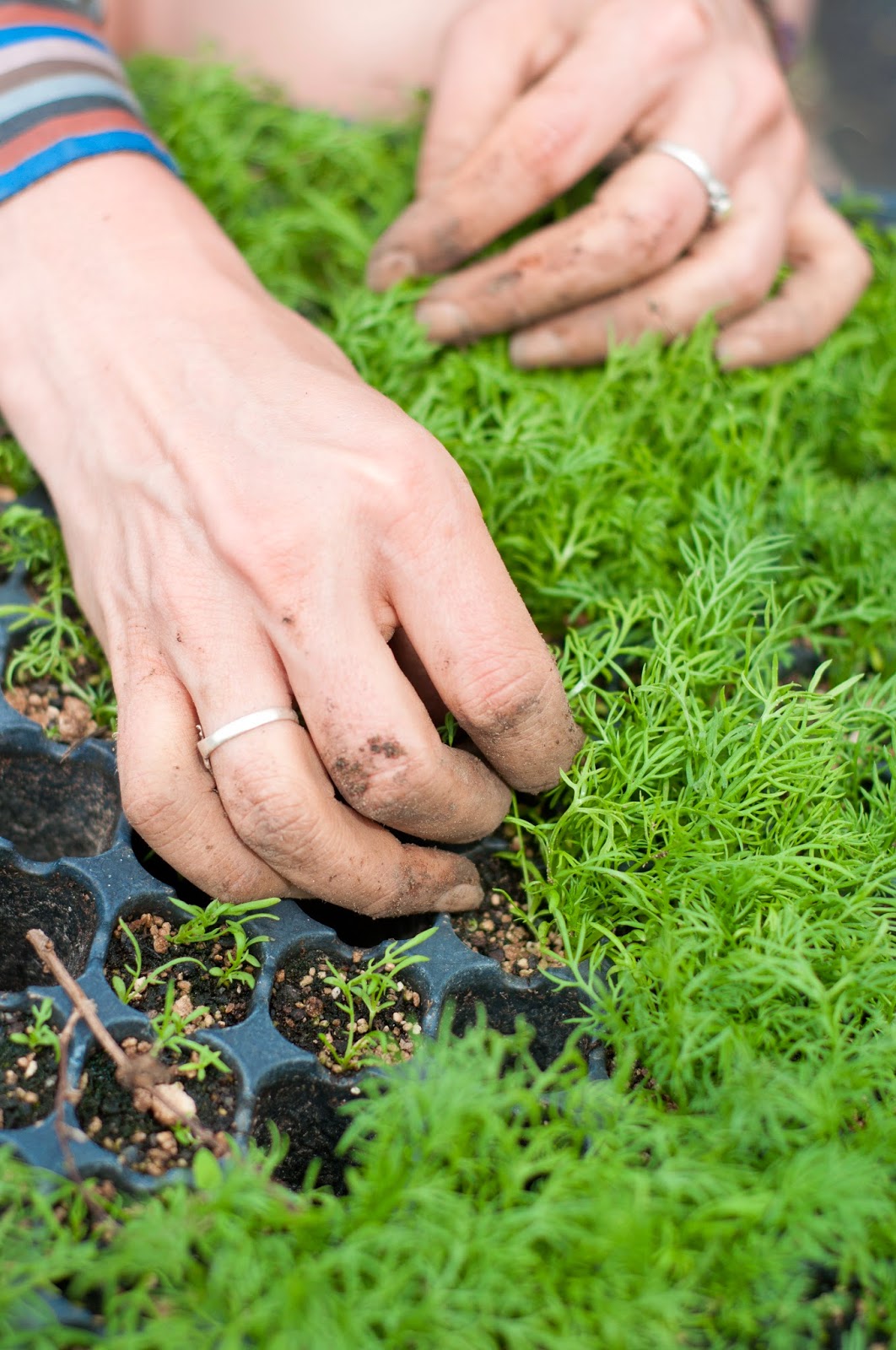
The time passed quickly with multiple hands at work and before we knew it the weeds were gone and it was time to wake up the nursery and start planing some seedlings. I watched and chatted with Holly as she placed the chamomile seedlings in neat little rows.


"I wish it was possible to get just one seed in each little hole, you know. It always ends up being these little clusters that you have to pull apart. But I'm going to plant them pretty close together so they grow up kinda bushy, like one big chamomile bush."

The slow, intentional act of planting is such a calming experience. 


I'll be helping Holly throughout her growing season this year and documenting the growth of the garden and I can't wait to learn more. She sent me home with a hyssop and several little chamomiles of my own that I dutifully planted in close knit rows. Now all there is to do is water and wait.